

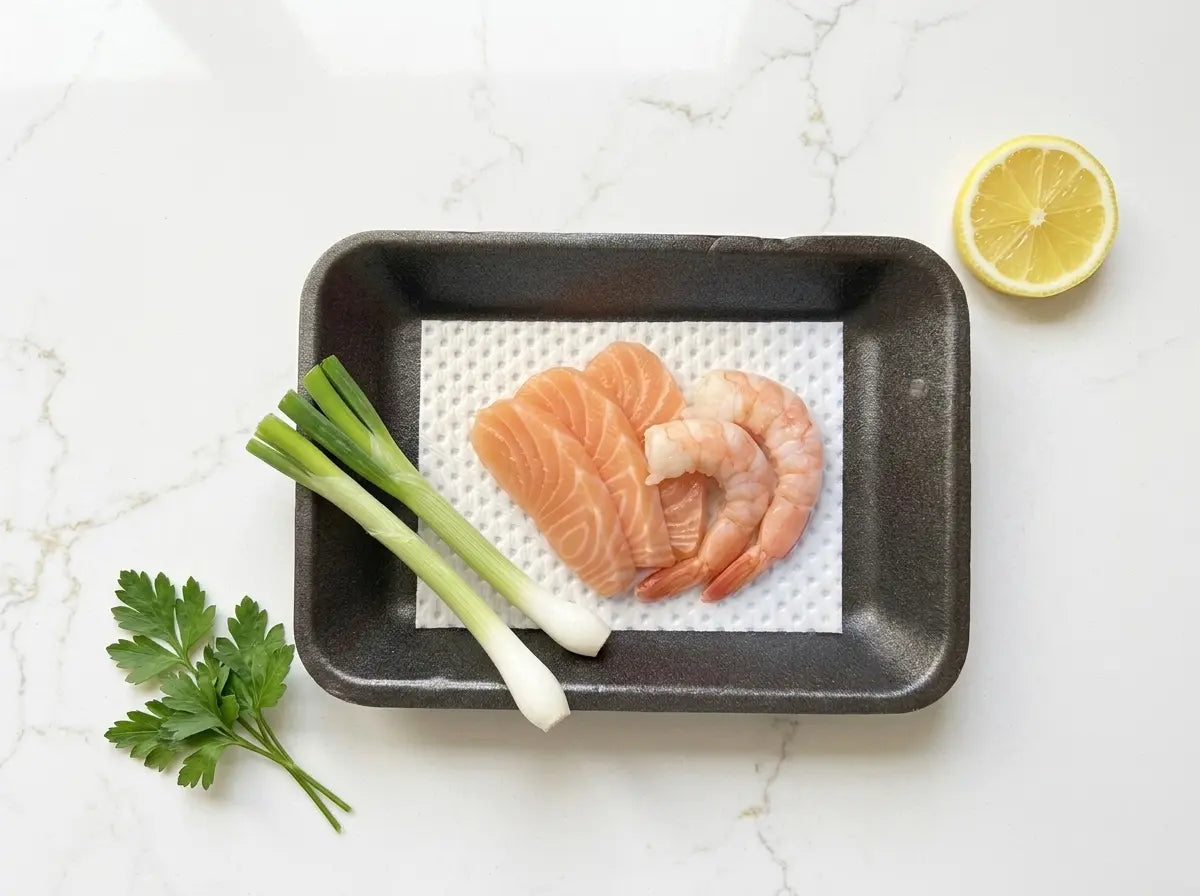
If you sell packaged meat, fish, or poultry, there's a good chance the absorbent pad under your product is plastic. Most soaker pads on the market are a cellulose core wrapped in perforated poly film — polyethylene (PE), the same plastic as a grocery bag. It does the job, but it can't be easily composted, it can't be recycled once soiled with food, and it quietly undermines every other sustainability effort in your packaging.
For large processors buying by the pallet, that trade-off is baked in. But if you're a small producer — an independent butcher, a fishmonger, a farm shop, a meal-kit brand — you have more freedom to choose, and more customers who notice what you choose. Here's what to know about going plastic-free under your food.
What's actually in a conventional meat pad
A standard soaker pad has two parts: an absorbent core (cellulose fluff, sometimes with superabsorbent polymer crystals) and a plastic film wrap that holds it together and keeps the wet core off the food. The film is perforated so liquid passes in one direction. The core itself is often plant-based — it's the PE film that makes the whole pad landfill-bound.
The compostable alternative: swap the film, keep the function
Compostable pads replace the PE film with a compostable polymer — commonly PBAT — bonded with natural fiber. PBAT is the same material family used in certified compostable produce bags: it behaves like a thin plastic in use, then breaks down in composting conditions. The pad still wicks drip away from the food and locks it in the core; the difference is what happens after the bin.
What to check before you switch
Absorbency, honestly rated. Conventional meat pads for heavy red-meat drip absorb a lot — often 40–75 grams. Compostable pads typically sit lower. Our own 130×90mm eco soaker pad holds around 15-20ml, which suits fish fillets, poultry portions, charcuterie, cheese, and larger produce — light-to-moderate drip. If you package heavy-purge cuts, use two pads or a higher-absorbency option. A supplier who won't state a number is telling you something.
Food-contact compliance. Pads touch food, so the materials should meet food-contact rules — in the US, look for FDA compliance on any adhesive or contact layer.
Minimum order quantities. The industrial suppliers who dominate this category sell by the case or pallet. If you go through a few hundred pads a month, that's a year of inventory and cash sitting in a storeroom. Look for suppliers who sell by the sleeve — it also lets you trial a compostable pad on one product line before switching everything.
Does it matter to customers?
Increasingly, yes — and disproportionately for small producers. A shopper at a farmers market or an independent fish counter is there partly because they care how their food is produced and packaged. A plastic pad inside an otherwise compostable tray is the detail that breaks the story. The reverse is also true: "even the soaker pad composts" is a genuinely differentiating line.
Where to start
Pick one product line with light-to-moderate drip — fish, poultry portions, mushrooms, berries — and run a single sleeve of compostable pads through it. Watch shelf appearance for a week, then decide with evidence. You can browse our full eco pad range, from 80×70mm produce pads to the XL 130×90mm size, all with no large minimums.


Leave a comment
This site is protected by hCaptcha and the hCaptcha Privacy Policy and Terms of Service apply.